

Note: As many of you know, before I spent every waking minute thinking about dad stuff, I had opinions about a variety of other topics. Today on Spinning Plates, I’m debuting a new feature, “The Dad Take,” where I “go off” on a non-parenting topic, refracted through the prism of parenthood.
Two weeks ago a violent extremist with a multi-decade career as an American Army sergeant killed almost 20 people during a shooting spree in Maine. Vice President Kamala Harris deemed the massacre an “unimaginable” act of violence, but I struggle to understand what precisely she finds difficult to fathom about a thing happens about twice per day in the country where we both live.
It’s important to dwell on the particulars of this incident, even though we’ve become accustomed to “yada yada yada-ing” mass murder. On last Thursday’s episode of The Daily, Michael Barbaro highlighted many “missed warnings” about the killer, while illuminating the complicity of American military and law enforcement officials in not just this incident, but in the ongoing cultural crisis. The details are shocking: the killer’s son and ex-wife reported his violent behavior to a school security officer. The school cop subsequently relayed the information to peers at the local police, who further passed the buck to the murderer’s superiors in the *checks notes* United States Military, who quietly had him institutionalized for psychiatric care after he subsequently punched a fellow Army reservist during a paranoid delusion at a training exercise.1
Each of those flaming red flags surfaced in the six-months leading up to the slaughter, and with hindsight we know that their bearer, Robert Card, was a dad, a non-commissioned officer of the American military, and a mass murderer.
Like countless other men who commit acts of “unimaginable” violence, Sergeant Card left a lot of hints that he was capable of imminent, terrible vengeance. He’s far from alone, as people who hurt others are much more likely to kill people with guns. A full two-thirds of mass shootings are linked to prior incidences of domestic violence, and in light of these linkages, it’s no surprise that large groups of women have mobilized, under the banner of motherhood, to address the issue.2
Dads as a group, on the other hand, are more or less missing from the conversation.
When I ask myself “where are the dads against gun violence?” I careen quickly to the brutal reality that men and dads are the ones doing the violence. American men are the global demographic most likely to settle their scores with guns, and half of all white men in the United States (48%) own firearms. That’s twice the rate for non-white men and women (both 24%), and a full 98% of mass shootings are carried out by men. It stands to reason, then, that our gender might bear the brunt of cultural redemption, but - despite a few visible exceptions - dads as a demo are absent from the fight.
It’s not just individual dads equivocating, though. The institutions that employ and arm American men - like the aforementioned United States military and their JV partners in municipal policing - exacerbate violent extremism.3 We never hesitate to ask “Where were you radicalized?” when non-Americans commit unspeakable acts, and yet we twiddle our thumbs while cops and GIs don’t just openly flaunt a culture of gun violence, but perpetrate it, daily.
In short, the people and institutions ostensibly erected to safeguard our freedoms are a primary source of the problem; as long as we allow the supply of unregulated guns to multiply, we ought to expect a concomitant culture of law enforcement that treats said proliferation as an arms race.
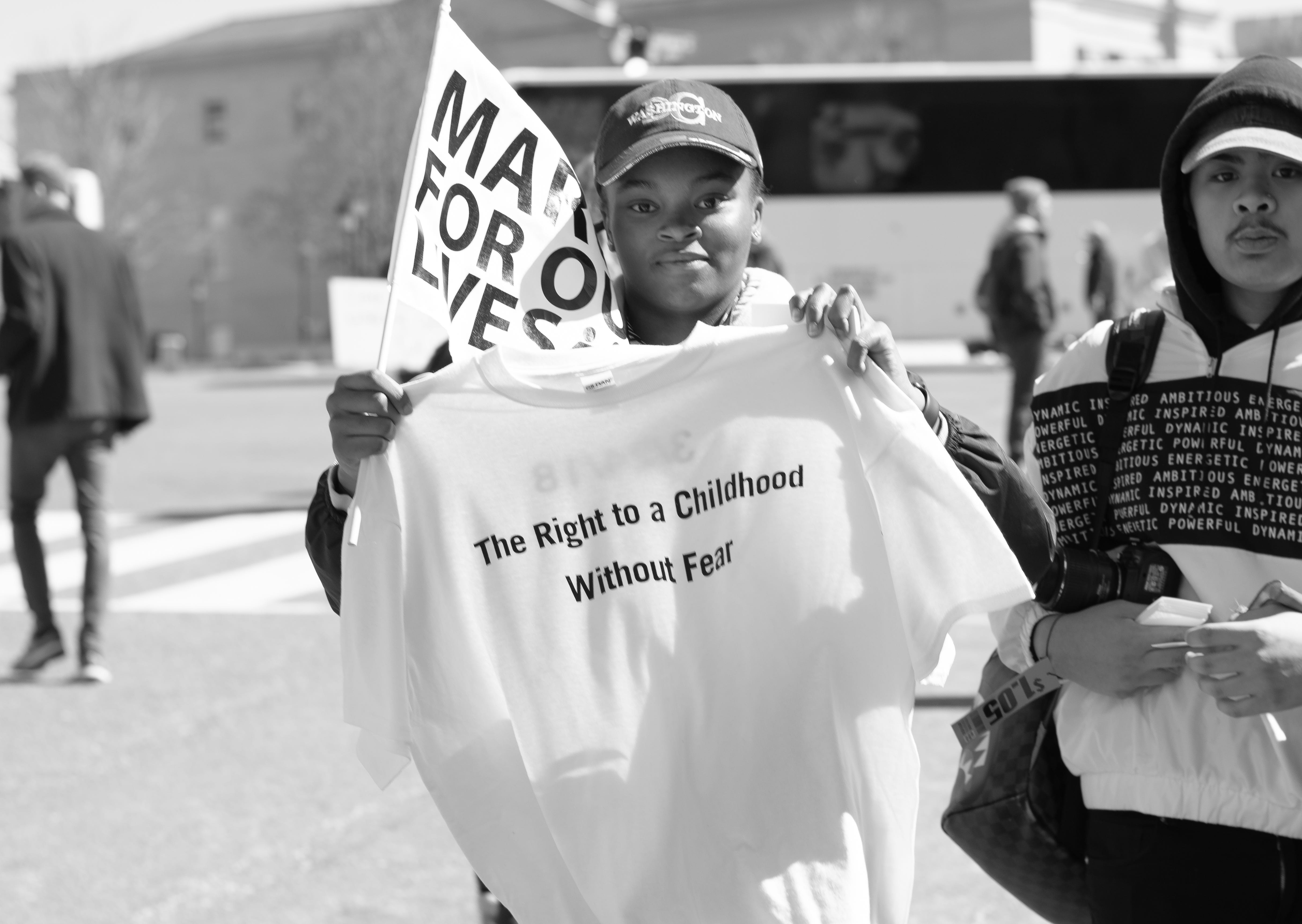
In the midst of this, how are the children?
Stephanie Malia Krauss, a parenting and education writer who ruminates about the interactions between gun violence and child development, wonders whether we can “raise children in a time of catastrophe without catastrophizing them.” That rhetorical question is not an abstraction for me, as my two-year-old already has multiple exposures to gun violence: she witnessed a shooting at a local playground before she was one, then a teenager shot another kid at the community center where she takes swim lessons.
Our society is fundamentally broken, and we - meaning men, specifically - refuse to take responsibility.
I’d love to end with something glib like “we can do so much better,” but I’m not confident that we can. When we started the #PoliticizeMyDeath campaign more than five years ago, things already seemed too dire to be redeemed through conventional means. And yet here we are in 2023, the powers-that-be still parroting pablum, while our kids catch strays that were designed, manufactured, marketed, and sold on the basis of extending American imperial might.
Someone or something has to de-escalate, and contemporary events are a good reminder that gun manufacturers, firearms lobbyists, law enforcement, the military, and a large plurality of our country’s political leadership actively benefit from propagating mass gun death here and abroad.
And when the chips are on the table, the AK sales revenues are tabulated, the high-capacity clips are reloaded, and the death tolls published, it’s one particular group of people laughing all the way to the blood bank:
American Men.
I’m not sure if we can do better. But we ought, at least, to try.
It’s also worth noting that Maine’s so-called “yellow flag” law did absolutely nothing to curb this incident, as such laws require - you know - enforcement, and as I’ll argue later, the cops don’t actually want to stop gun violence, in part because they depend on its perpetuation for their ever escalating budgets and concomitant weaponry hoarding.
To be fair to dads, though, Moms Demand Action and their overlords at Everytown for Gun Safety are not terribly effective, as they have made almost no progress on these issues over the course of their existence, while consuming an increasingly large share of all of the domestic philanthropy available to fight gun violence.
This happens in a bunch of ways, but two are worth dwelling on. First, and foremost, American police and military officials act in deliberately violent and unaccountable ways. If you need me to justify that assertion, you’re living on another planet. Second, our policing and prison systems act as, what a German friend of mine once called, “crime graduate school,” by channeling young men early, and in some cases perpetually, into violent detention camps where they are further indoctrinated into a culture of violent crime and even more violent punishment.